Introduction: Executive Computing
Introduction: Executive Computing
Around 1980, a computer consultant in Boston, John M. Nevison, wrote a book entitled Executive Computing, with the enticing sub-title, “How to get it done on your own”. The book was published by Wiley and was popular enough to go through multiple printings. I own a copy of the fifth printing from 1985.1
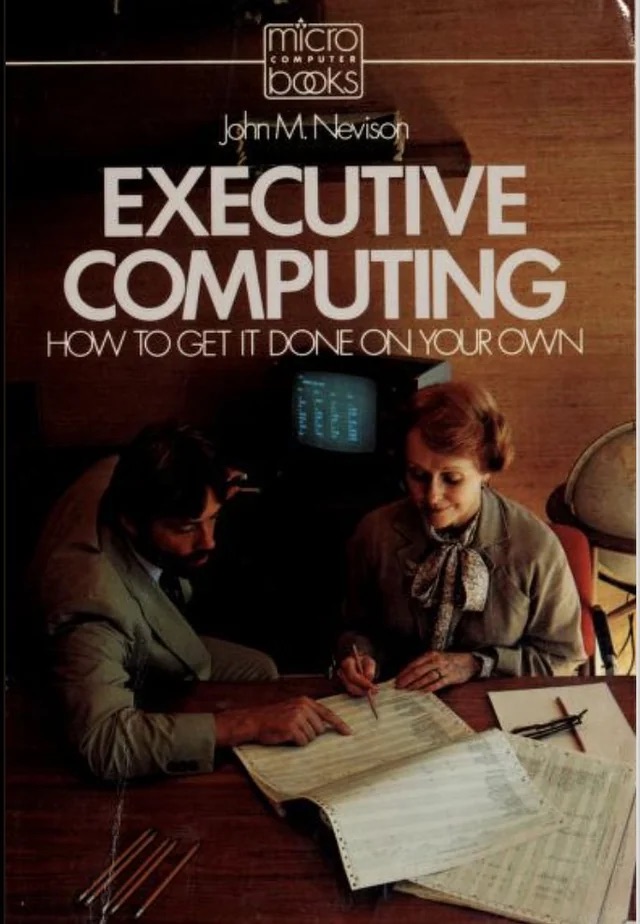
The cover does an excellent job of conveying the goal of the book, as well as a bit of the flavor of the times. The idea is to free yourself from the tyranny of the mainframe. Do it all yourself with a relatively inexpensive business computer. The book is truly excellent, with a nice blend of appropriately cheesy instructional scenarios and very clear, well-explained code.
The book was targeted at users of Radio Shack Level II BASIC on a TRS-80 computer. Level II BASIC was a 16K BASIC, written by Microsoft, that included floating point numbers in both single and double precision. The computer was available starting in 1978. According to Nevison’s book, a TRS-80 Model I with 16K RAM and Level II BASIC cost $849 (approximately $3,440 in 2026). This got you a monitor and a keyboard with real keys. Data storage was via cassette tape.
There are a number of TRS-80 emulators out there. I’m using trs80gp - A TRS-80 Model 1,2,3,4,12,16,6000,Tandy 10,MC-10,Color Computer,DT-1,Green Thumb,Videotex Emulator, which seems to work just fine. It’s cross-platform; I’m currently running it on a Mac.
To run the emulator and boot into the Level II BASIC ROM, try: ./trs80gp -m1 -l2 -mem 16 -dx. The most important thing to know is that the BREAK key from the TRS-80 is mapped to the ESC key, at least on my Mac. If you type AUTO to auto-number BASIC program lines, you’ll need to hit ESC to get back to the prompt.
Incidentally, one of the interesting things about Nevison’s book is that it is written in the looming shadow of VisiCalc. Appendix D introduces VisiCalc and notes that many of the programs in the book could be re-written to run in newfangled VisicCalc. Forty-odd years later, we know how that turned out.
Anyway, I’d like to use Nevison’s book to explore an alternate future, where Forth was the bundled language and business users adopted Forth as their “basic” language of choice. Stop laughing! It could have turned out this way, maybe. Just think of HP’s calculators and their success in scientific and financial applications.
I am not an expert Forth programmer - quite the opposite. After using BASIC as a youngster, I spent some years with Pascal and then many years with Python. Forth does not come naturally to me. That’s the challenge and the fun of it. Join me next time as I make my way down this rabbit hole.
-
Nevison, J. M., (1981) Executive Computing–how to get it done on your own. Addison-Wesley Publishing Company, Inc. https://archive.org/details/executivecomputi00nevi/page/n1/mode/2up ↩